Wednesday, January 14, 2009
People’s Coalition calls on Supreme Court to uphold Philippine Constitution as Japan-RP Pact Takes Effect Tomorrow
The MJJC made this call in view of the Court’s inaction despite the looming implementation of the JPEPA, which is expected to take effect on Thursday.
It will be recalled that the MJJC on October 13, 2008 questioned the constitutionality of JPEPA and implored the Supreme Court to halt its implementation.. Petitioners include the Alliance of Progressive Labor, Concerned Citizens Against Pollution, EcoWaste Coalition, Initiatives for Dialogue and Empowerment through Alternative Legal Services Inc., Kilusan Para sa Pagpapaunlad ng Industriya ng Pangisdaan, Mother Earth Foundation, NGOs for Fisheries Reform, Philippine Metal Workers Alliance and Akbayan Rep. Ana Theresia Hontiveros-Baraquel
“We have seen that the Supreme Court is perfectly capable of acting expeditiously on matters of grave national importance. Why then is it dragging its feet on an agreement that is potentially more devastating than Philippine membership in the World Trade Organization and is blatantly unconstitutional?” Atty. Golda Benjamin, lead counsel of the MJJC, asked.
Philippine Foreign Affairs Secretary Alberto Romulo and Japanese Ambassador Makoto Katsura had exchanged diplomatic notes last month and set December 11, 2008 as the date that the JPEPA would enter into force. JPEPA opponents had filed a case with the Supreme Court questioning the constitutionality of the trade treaty and asking for a restraining order which the High Court had declined to grant.
“We ask the Honorable Supreme Court to give justice to the millions of poor Filipinos who will suffer needlessly because of the government’s failure to protect their rights and interests during the negotiation of the JPEPA. We call on our Honorable Justices to abide by their solemn duty to uphold the Philippine Constitution and defend the interests of the Filipino people,” Benjamin stated.
The MJJC also called on all Filipinos to exercise continued vigilance in the light of the impending implementation of the JPEPA.
“Philippine officials have asked us to ‘give JPEPA a chance.’ What they are really saying is, we have no choice but to accept the JPEPA because it’s already there. We refuse to accept such a defeatist attitude,” Josua Mata, Secretary General of the Alliance of Progressive Labor, said.
“Contrary to what some JPEPA apologists are saying, implementing JPEPA would only hasten the collapse of our industrial capacities that are now tottering as a result of the global crisis. After all, JPEPA severely constricts our policy space in the areas of trade and investments,” Mata added.
The MJJC will monitor the implementation of the JPEPA very closely, publicly disclose its ill effects and hold government officials accountable and liable.
“We choose not to be defeated. This battle -- for economic justice, environmental integrity, national sovereignty, and Philippine pride -- is far from over,” the MJJC said.
The MJJC, a multisectoral people’s coalition, has vigorously campaigned for the Senate rejection of JPEPA on economic, environmental, constitutional, legal and ethical grounds.
Sunday, October 12, 2008
An act of national betrayal
Sixteen votes to approve the JPEPA. Sixteen votes to sell the Filipino people’s freedom, dignity, and future. Sixteen votes [that said] affirming:
* a treaty that is admittedly weak and badly negotiated is good enough for the Filipino people.
* it is correct to violate Philippine laws and the Constitution to accommodate the requests of a powerful and rich nation such as Japan.
* it is correct to accept that Filipino nurses can be discriminated against.
* it is correct to allow a rich nation like Japan to protect its fishermen and farmers while Philippines [negotiators] abandoned their own.
* It is acceptable to foresake the environment and health of Filipinos by allowing toxic wastes and other poisonous substances to be commodified under a trade agreement.
* it is correct to say that the Filipino is not good enough to be protected and defended.
In the midst of financial and political turmoil, countries are fighting to protect their own people, uphold national interest, and ensure that the lives and livelihood of their citizens are defended according to the demands not only of law but of basic demands of justice and human rights.
On the Senate floor, only four rightful representatives of the people voted to stand up for the Filipino, with the Filipinos. These are today’s heroes: Senator Jamby Madrigal, Senator Chiz Escudero, Senator Noynoy Aquino, and Senator Nene Pimentel. They did what they swore to do: serve the Filipino people.
We, the members of the Magkaisa JUNK JPEPA Coalition, are enraged by this shameful act performed was once the hallowed floors of the Senate. The fight for this nation cannot be made to end in their bloodied hands. These sixteen people cannot take part in the determination of this country’s future. Never again shall we allow cast our vote to call them leaders.
We will march on and invoke the wisdom of the highest court of the land.
We refuse to mourn for this act against the people. We choose not to be defeated. We choose to fight against any and all attempts to sell this proud nation and its people to the highest bidder.
We call on every Filipino to join us in our continuing struggle and NOT to forget the injustice that these 16 Senators did today.
Para sa Pilipas.Para sa Pilipino.
Magkaisa JUNK JPEPA.
Thursday, October 9, 2008
An Act of National Betrayal: Senate Approves JPEPA
In an act of national betrayal, sixteen so-called representatives of the people voted to approve the Japan-Philippines Economic Partnership Agreement.
Sixteen votes to approve the JPEPA. Sixteen votes to sell the Filipino people’s freedom, dignity, and future. Sixteen votes that said:
- a treaty that is admittedly weak and badly negotiated is good enough for the Filipino people
- it is correct to violate Philippine laws and the Constitution to accommodate the requests of the powerful and rich nation, Japan
- it is correct to accept that Filipino nurses can be discriminated against
- it is correct to allow a rich nation like Japan to protect its fishermen and farmers while Philippine negotiators abandoned them.
- it is correct to say that the Filipino is not good enough to be protected and defended.
In the midst of financial turmoil, countries are fighting to protect their own people, uphold national interest, and ensure that the lives and livelihood of their citizens are defended according to the demands not only of law but of basic demands of justice and human rights.
On the Senate floor, only four rightful representatives of the people voted to stand up for the Filipino, with the Filipinos. These are today’s heroes: Senator Jamby Madrigal, Senator Chiz Escudero, Senator Noynoy Aquino, and Senator Nene Pimentel. They did what they swore to do: serve the Filipino people.
We, the members of the Magkaisa JUNK JPEPA Coalition, are enraged by this shameful act performed on the floors of the Senate. The fight for this nation cannot be made to end in their bloodied hands. These sixteen people cannot take part in the determination of this country’s future. Never again shall we allow cast our vote to call them leaders.
We will march on and invoke the wisdom of the highest court of the land.
We refuse to mourn for this act against the people. We choose not to be defeated. We choose to fight against any and all attempts to sell this proud nation and its people to the highest bidder.
We call on every Filipino to join us in our continuing struggle and NOT to forget the injustice that these 16 Senators did today.
Para sa Pilipas.Para sa Pilipino.
Magkaisa JUNK JPEPA.
- Magkaisa JUNK JPEPA Coalition
Saturday, August 30, 2008
Experts cite illegality and failed trade objectives in JPEPA
Constitutional, international law expert and former dean of the UP College of Law, Prof. Merlin Magallona, and former commercial attaché and former director of the Department of Trade and Industry Bureau of International Trade Relations, Ms. Edna Espos weighed the constitutional and trade issues facing the JPEPA, and gave the treaty a thumbs down, concluding that the JPEPA will make the Philippines and the Filipinos big losers to Japan.
Unconstitutionality of JPEPA
“JPEPA is an essential aspect of the Japanese relocation strategy and JPEPA’s benefits will be accruing to the Japanese subsidiaries in the Philippines,” explained Magallona.
In his analysis, Magallona dissects how the JPEPA by granting extensive national treatment principle gives away to the Japanese sacred Constitutional rights reserved for Filipinos, such as to own land in the Philippines, the right practice certain professions, operate and administer educational institutions. This essentially places Japanese nationals and their investments at parity with Filipinos.
According to Magallona, if very little preference is extended to the Filipino vis-à-vis the Japanese investors under the JPEPA, what is the value of being a Filipino in your own national economy?
On the issue of the pending exchange of notes that Sen. Miriam Defensor-Santiago claims will address the Constitutional issues in JPEPA, Magallona was cautious; elaborating that without the benefit of seeing the actual document it would be very difficult to come up with a definitive analysis favorable or otherwise..
He raised concerns, however, on the impact of the notes on the JPEPA if it is executed merely between the Philippine and Japanese Executive branches, noting that the JPEPA was ratified by the Japanese Diet and is pending concurrence by the Philippine Senate. Any amendment to the agreement entered into by the Philippines with Japan should at least go through a similar process, at a minimum.
Failed Trade Objectives
“Sen. Roxas’ established two tests to gauge the success of JPEPA: first, did we achieve our negotiating objectives, and second, did we gain more than we gave up. The answer to these tests is a resounding no,” exclaimed Espos at the start of her critique on the trade value of JPEPA to the Philippines.
One of the goals for entering into JPEPA, according to Espos, is to gain market access for Philippine exports to Japan. In order to achieve this goal the Philippines under JPEPA drastically eliminated tariffs across the board, exempting only 6 tariff lines for rice and salt and negotiated on issues that it would not even do so under the World Trade Organization.
Instead of reciprocating the gesture, Japan on the other hand, excluded from the coverage of JPEPA at least 197 tariff lines, constituting mainly agricultural and marine products for which the Philippines has competitive advantage. The long list of Japanese exclusions, long-term phase out of tariffs, and deferred market negotiations under JPEPA severely restricted agricultural gains by the Philippines under JPEPA.
Espos further explained that the purported easier market access for electronics, furnitures, and automotive parts under JPEPA is not entirely true. Even without the JPEPA, these products already enter Japan duty-free; JPEPA did not change anything. Philippine garments and footwear exporters cannot take advantage of the duty-free provision under JPEPA because their raw materials do not comply with JPEPA Rules of Origin (ROO), which mandates in part that the raw materials come primarily from Japan or any of the ASEAN countries.
A crucial item that the Philippines failed to get after giving up so much was the removal of the enormous Japanese agricultural subsidy (including subsidies on fishing industry) that aversely affects millions of Filipino farmers and fisherfolks who cannot compete with subsidized products both abroad and at home.
Espos elaborated on the inequity of the JPEPA, by citing that the Philippines eliminated its fish tariffs under JPEPA, but Japan will not even commit to reduce its subsidies on its fishing vessels and will in fact even exclude fish products from the JPEPA.
“We gave up everything, and gained nothing under JPEPA. This is the sorry conclusion facing us with JPEPA,” stated Atty. Golda Benjamin, lead counsel for MJJC. “For a treaty that is so patently unconstitutional and for its failure to obtain the needed gains for Filipino farmers, fisherfolks, workers and exporters, there is only one logical, just, and moral step that the Senate can take, and that is to reject JPEPA.”
Wednesday, August 20, 2008
Toxic wastes in JPEPA a real threat
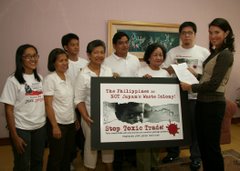
12 August 2008, Quezon, City – “The threat posed by toxic wastes in the JPEPA is very real for Filipinos. It behooves our Senators to address this threat and not pretend that it is not there,” stated Marie Marciano, President of Mother Earth Foundation and a member of the multi-sectoral movement called the Magkaisa Junk JPEPA Coalition (MJJC) that held a creative protest in front of the Senate today.
Members of various environmental groups participated in the creative protest in which mock figures of President Gloria Macapagal-Arroyo and Senators Mar Roxas and Miriam Defensor-Santiago sat on toxic waste barrels marked JPEPA, miming the common phrase “see no evil, speak no evil, hear no evil”. In this instance the three figures are metaphorically washing their hands of JPEPA and the toxic waste nightmare it will bring.
In May of 2007, Japanese Foreign Minister Taro Aso executed a side note expressing Japan’s promise not to export hazardous wastes to the Philippines, as long as it follows Philippine and Japanese laws, as well as the international treaty on toxic wastes known as the Basel Convention. According to Atty. Richard Gutierrez, Executive Director of Ban Toxics!, it is not sufficient to rely on Japan’s promise not to export toxic wastes to the Philippines because there are physical and financial incentives for Japan to export its wastes.
Citing data from the Japanese Ministry of Environment, Gutierrez stated that Japan has been generating over 50 million tons of wastes per year for the past 10 years. Because of their continued generation of waste Japan only has 13.2 years left of physical space in their landfills to dispose of their municipal waste. For their industrial wastes, the Japanese only have 6.1 years left in their landfills.
“It’s simple physics, two bodies cannot occupy the same space at the same time. You either move the Japanese out of Japan or you move the waste out of Japan. This is a no brainer,” stated Gutierrez.
“In terms of cost, the Japanese are spending 2 trillion Yen per year to deal with their wastes,” continued Gutierrez. “Why not export these wastes in the guise of raw materials to poorer countries and save money on the processing cost in Japan? This is a win-win for Japan and a major loss for the country accepting the toxic wastes.”
The environmental groups also mentioned that Japan is struggling with the growing cases of illegal dumping within its borders and data from Thailand and India have revealed that Japan is already exporting toxic wastes to these countries under existing Japanese and international laws.
According to Marciano, the promise to follow laws is not sufficient. “We need to take into account that all these laws define toxic wastes the same way and that they are all implemented rigorously. The fact that Japan is able to export toxic wastes to Thailand and India for the past three years is evidence that Japanese law and the Basel Convention do allow toxic wastes exports.”
In her privilege speech to the Senate sponsoring the ratification of the controversial treaty, Sen. Defensor-Santiago expressly stated that the Senate is recommending to Malacañang the ratification of the Basel Ban Amendment.
“If Malacañang does not endorse the Basel Ban Amendment to the Senate for ratification, this will recommendation will go nowhere,” said Gutierrez “Filipinos have the Constitutional right to a healthful ecology. This is a right based on a legal obligation not on convenience. The Filipino health and environment must constantly be protected, and not when it is politically convenient.”
Wednesday, August 13, 2008
NGO Leaders from 30 Countries Call for Senate Rejection of JPEPA, Warn against Chemical Trespassing via Toxic Waste Trade
In an open letter faxed today to the office of Senate President Manny Villar, 66 non-governmental organization (NGO) leaders from 30 countries currently gathered in Trivandrum, capital city of Kerala state, India for a global conference on chemical safety urged the senators to desist from ratifying the controversial pact.
Among the signatories were member groups of the International Persistent Organic Pollutants Elimination Network (IPEN), Pesticide Action Network (PAN) and the Global Alliance for Incinerator Alternatives (GAIA) from Africa, Asia-Pacific, Europe, Latin America and the Caribbean, and North America.
“We trust that the Philippine Senate will heed what the local and international civil society groups are saying and be proactive in protecting the Filipino people and the environment from chemical trespassing through toxic waste trade,” Australian lawyer Marian Lloyd-Smith, IPEN Co-Chair, said.
“As groups engaged in the global movement to cut pollution that impairs the health and wellbeing of the people and other creatures in this planet, we empathize with the steadfast stance of public health and environmental justice groups in the Philippines against JPEPA, a treaty that promotes trade in toxic waste,” the open letter reads.
“We join the Filipino people in appealing to the members of the Senate to reject JPEPA, ratify the Basel Ban Amendment, plug loopholes in waste and customs laws to stop toxic waste trade, and initiate policies, applying the principles of precaution and prevention, that will protect the people and the environment from the adverse toxic effects of chemicals,” the open
letter states.
The EcoWaste Coalition, a partner group of GAIA and IPEN in the Philippines, obtained a copy of the letter to the senators, which the group warmly welcomed and circulated to the local press.
“We laud this timely support from our colleagues abroad for the trashing of the discredited JPEPA because of the treaty’s barefaced defects to stand up for the public welfare, the environment and the Constitution,” Manny Calonzo of the EcoWaste Coalition and GAIA said.
In their open letter, the groups reminded the senators that “the Philippines is already struggling with the wastes it generates, and with the widespread lack of information on the toxicity and environmentally-safe management of its wastes," a situation that will not be helped by ratifying JPEPA.
They explained that “the inclusion of hundreds of toxic materials and wastes for zero tariff elimination, including persistent organic pollutant(POP) wastes, nuclear wastes, ozone depleting substances and many other globally banned and controlled chemicals and substances provides unambiguous indicator that trade in toxic wastes is promoted under the pact.”
“The fact that neither Japan nor the Philippines has ratified the Basel Ban Amendment, which prohibits the export of toxic wastes from developed to developing countries for all intents and purposes, including recycling and disposal, makes us wary beyond doubt of the plausible dumping of toxic wastes, including electronic wastes, into the Philippines, turning the country's islands into convenient dumps for all types of garbage from overseas,” they emphasized.